The Fire Next Time: Why California Homeowners Are Feeling the Heat
The Miller family has called the foothills above San Bernardino home for nearly thirty years. Their two-story house, nestled among mature oaks, has seen grandkids grow up and countless sunsets paint the peaks of the Inland Empire. For decades, home insurance was just another bill that arrived, paid, and forgotten. Not anymore. Last fall, their long-time insurer, one of the big names you’d recognize, sent a non-renewal notice. Just like that.
Suddenly, the Millers were scrambling. They weren’t alone, not by a long shot. Across California, from the winding canyons of Ventura County to the golden hillsides of the Sierra Nevada foothills, homeowners are getting similar letters. Premiums are jumping – sometimes 40% or more between 2022 and 2024. Policies are getting canceled. It’s a seismic shift in how folks protect their biggest asset.
For a long time, insurance companies could spread the risk around. A big fire in Malibu might be offset by years of quiet elsewhere. But something has changed. Fire season isn’t just a season anymore; it feels like a year-round threat. And when homes burn, they burn big.
A Perfect Storm: What’s Driving Up Premiums?
Honestly, there isn’t just one reason. It’s a combination of factors, a real collision of forces that makes insuring a California home much harder than it used to be. The climate is certainly a major player. We’re seeing hotter temperatures, longer droughts, and more intense wind events. This creates perfect conditions for wildfires to ignite and spread rapidly. Remember the sheer devastation in Paradise or the fires that swept through parts of the Santa Cruz Mountains? Those aren’t isolated incidents anymore; they’re becoming more common, more destructive.
Which brings up something most people miss. When a fire tears through a community, it’s not just the immediate loss. Rebuilding costs have skyrocketed. Materials are more expensive, thanks to supply chain hiccups and inflation. Labor is harder to find and costs more too. So, an insurer looking at a house in, say, the Valley, isn’t just thinking about the chance of a fire; they’re also calculating the astronomical cost if they have to rebuild it from the ground up.
Add to this the fact that many insurers are simply choosing to write fewer policies in high-risk areas. State Farm, AAA, Farmers – many of these big carriers have either paused new policies or significantly tightened their underwriting rules. They’re making a business decision, trying to limit their exposure to massive losses. That leaves fewer options for homeowners, driving up prices for the policies that are still available. It’s a tough spot for everyone involved.

Your First Line of Defense: Brush Clearance and Defensible Space
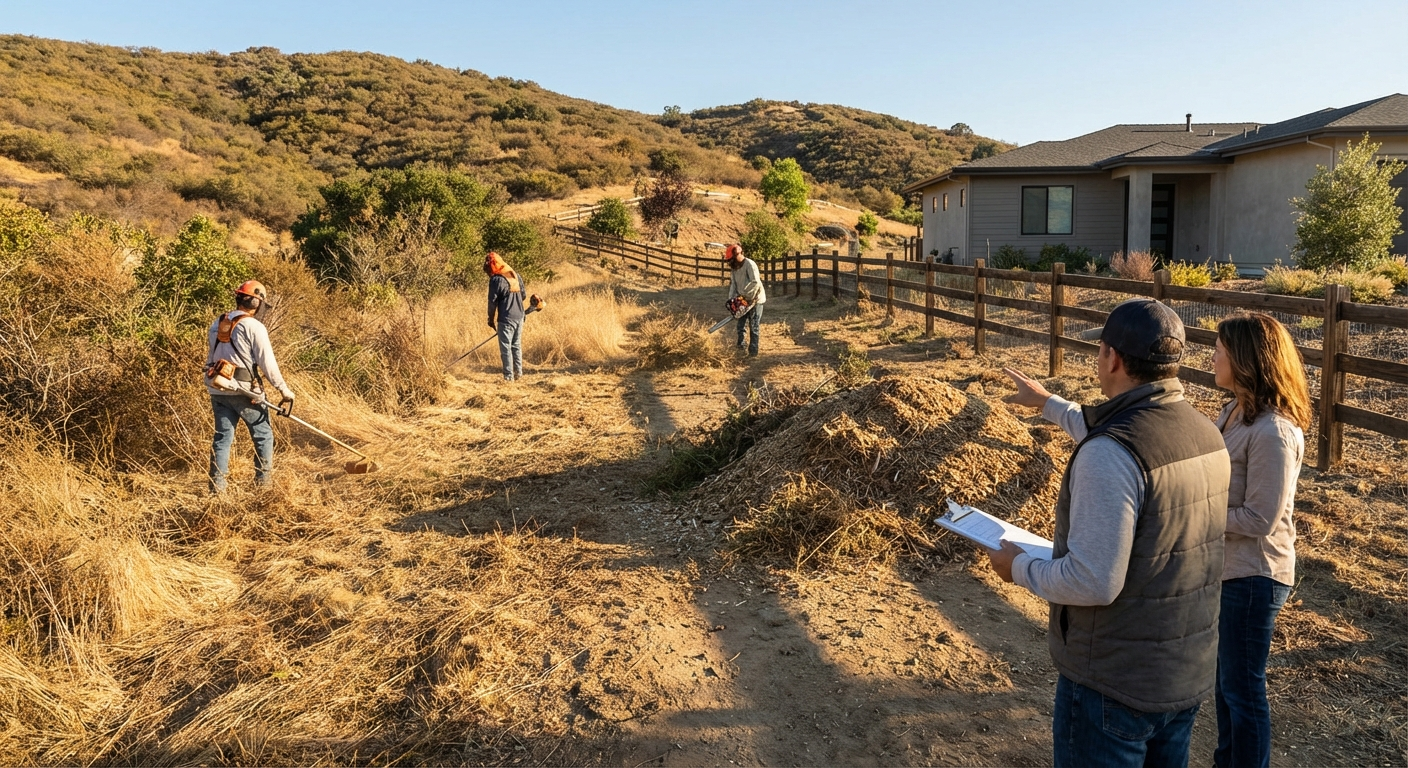
The Millers, after getting that non-renewal, started looking at their property differently. They’d always kept things tidy, but now they were studying the details, really understanding what “defensible space” meant. It’s not just a nice-to-have; it’s often the single biggest thing you can do to protect your home from wildfire. More than that, it’s becoming a requirement for getting – and keeping – fire insurance in California.
Think of it like this: your house isn’t just sitting there. It’s surrounded by fuel. Dry grass, dead leaves, low-hanging tree branches, even a pile of firewood too close to the wall. All of it can catch fire and carry flames right to your doorstep. Defensible space creates a buffer, a zone where fire has less fuel to work with, slowing it down and giving firefighters a better chance to save your home.
This isn’t some vague concept. California’s fire agencies break it down into specific zones.
* **Zone 1 (0-5 feet from your home):** This is the most critical area, sometimes called the “ember-resistant zone.” Here, you want absolutely no flammable materials. Think concrete patios, gravel, clear ground. Remove all dead plants, leaves, and needles. Trim any tree branches that hang over the roof. Move outdoor furniture and wood piles away.
* **Zone 2 (5-30 feet from your home):** This zone needs lean, clean, and green vegetation. Reduce the amount of flammable plants. Keep grass cut short. Space out shrubs and trees so flames can’t easily jump between them. Remove dead branches and lower limbs, especially those within 6 feet of the ground.
* **Zone 3 (30-100 feet from your home, or to the property line):** This is where you reduce the density of fuels. Thin out trees and shrubs, remove small trees growing between larger ones. Cut down dead trees. This zone helps reduce the intensity of a fire as it approaches your property.
Insurers, increasingly, are looking for proof you’ve done this work. They’re using satellite imagery, drone footage, and sometimes even sending out inspectors. They want to see that you’re taking proactive steps to reduce the risk. It’s a partnership, really: you do your part to protect your home, and they do their part by offering coverage.
The Nitty-Gritty of Defensible Space
It sounds like a lot, right? But it’s really about consistent maintenance. The Millers now have a regular schedule. Every fall, they clear their gutters of pine needles and leaves. Twice a year, they walk their property with clippers and a rake, checking the zones. They’ve moved their firewood stack to the far corner of the yard, well away from the house. They even replaced an old cedar shake roof years ago with a fire-resistant tile one, which, honestly, was a smart move long before their insurance troubles.
Remember, a fire department inspection can happen. Many counties and cities, especially in high-risk areas like the Santa Monica Mountains or around Lake Tahoe, have strict brush clearance ordinances. If you don’t comply, you can face fines. More importantly, if your property isn’t cleared, it could make it impossible for firefighters to safely defend your home. It’s not just about getting insurance; it’s about making your home defensible.
When Traditional Insurance Says “No”: Understanding the FAIR Plan
For many California homeowners, like the Millers, the biggest shock comes when they realize their long-time insurer won’t renew their policy. So, what then? For a lot of people, the California FAIR Plan becomes the only real option.
The FAIR Plan isn’t a private insurance company. It’s California’s “insurer of last resort.” If you can’t get fire insurance from a traditional carrier, the FAIR Plan is designed to provide basic coverage. It’s a lifeline, no doubt. But it’s not the same as a standard homeowner’s policy.
Typically, the FAIR Plan covers fire, lightning, internal explosion, and smoke damage. That’s it. It doesn’t cover things like liability, theft, water damage, or personal property beyond what’s damaged by fire. So, if you go with the FAIR Plan, you’ll almost certainly need to buy a separate “Difference In Conditions” or “wrap-around” policy from a different carrier. This covers all those other perils.
And here’s the thing: between the FAIR Plan policy and the wrap-around, your total premium is often significantly higher than what you paid for your old, all-in-one policy. It’s also worth noting that while Prop 103 gives the state’s Insurance Commissioner power over rates, even the FAIR Plan has seen its rates climb as the cost of fire damage continues to rise. It’s a necessary safety net, but it’s rarely the ideal solution.
The Insurer’s Perspective: What They See From Above
Think about it from an insurance company’s point of view. They’re trying to assess risk on a massive scale. They can’t send an inspector to every single property. So, they’ve turned to technology. They’re using sophisticated satellite imagery and AI models to evaluate properties. They can see the slope of your land, how close you are to wildland areas, the type of vegetation on your property and your neighbors’.
They can also spot things like roof materials – is it old wood shake or modern tile? They’ll look at the access roads for firefighters, the proximity to a fire station, even the type of power lines in your neighborhood. All of these factors feed into their risk calculations.
But here’s where it gets interesting: brush clearance is highly visible from above. An insurer can look at an aerial photo and often tell if a property has a clear defensible space. If they see heavy, uncleared vegetation right up against your home, that’s a red flag. It tells them you’re a higher risk, and it makes them less likely to offer you a policy or more likely to charge you a much higher premium. Your efforts in brush clearance aren’t just for your safety; they’re a signal to the insurance company that you’re a responsible homeowner.
Finding Your Way Through the Smoke: Getting the Right Coverage
So, what’s a California homeowner to do? It’s true, finding good fire insurance is tougher than it used to be. But it’s not impossible. This is where an experienced, independent insurance agent becomes invaluable. They’re not tied to just one company. They work with many different insurers, including those smaller, specialized carriers that might still be writing policies in areas where the big names have pulled back.
Someone like Karl Susman, with LA Fire Coverage Insurance, CA License #0B75129, has seen it all. He understands the nuances of the California market – the specific requirements, the shifting appetites of different carriers, and the ins and outs of the FAIR Plan. He and his team know which questions to ask and which insurers might be the best fit for your unique situation. They’re not just selling policies; they’re helping you navigate a really complex system.
If you’re feeling lost in the insurance maze, it’s always smart to talk to someone who understands the unique challenges of California’s fire season. Karl Susman and the team at LA Fire Coverage Insurance, CA License #0B75129, have helped countless homeowners find protection. Get a quote today and see your options.
What You Can Do Now
First, don’t panic. Take a deep breath. Then, get proactive. Assess your property with defensible space in mind. Take photos before and after you do brush clearance work. Keep receipts for any professional clearing services. This documentation can be helpful if an insurer asks for proof.
Next, start shopping around well before your current policy expires. Don’t wait until the last minute. The more time you have, the more options you might find. Be honest about your property’s risks, but also highlight the steps you’ve taken to mitigate those risks.
Finally, stay informed. Local fire departments often have resources and workshops on brush clearance. Understanding your specific local ordinances and the latest fire safety guidelines can only help you protect your home better.
FAQs About California Fire Insurance and Brush Clearance
Does brush clearance guarantee I’ll get insurance?
No, unfortunately, brush clearance doesn’t guarantee you’ll get a traditional fire insurance policy, especially in very high-risk areas. However, it significantly improves your chances. Insurers look for proactive risk mitigation. Without proper brush clearance, your odds of getting coverage are much, much lower.
What if my neighbor doesn’t clear their brush?
This is a common concern. While you can’t control your neighbor’s property, you are responsible for your own defensible space. Many local fire departments have ordinances that require property owners to clear brush. If your neighbor isn’t complying, you can often report it to your local fire marshal or code enforcement. Maintaining your own clear zones, especially the critical 0-5 foot area, is still very important for your home’s protection.
Is the FAIR Plan my only option if I’m non-renewed?
Not always. The FAIR Plan is the insurer of last resort, but an independent agent like Karl Susman might be able to find a specialized carrier that’s still writing policies in your area. These smaller carriers often have different risk models. It’s always worth exploring all your options before settling for the FAIR Plan and a separate wrap-around policy.
How often do I need to clear my property?
Generally, brush clearance is an ongoing effort. Most experts recommend at least an annual clearing, typically before the peak of fire season (late spring/early summer). However, if you live in an area with fast-growing vegetation or frequent wind events that bring down debris, you might need to do it more often. Keep an eye on your property and maintain those defensible space zones year-round.
Can I get a discount for brush clearance?
Some insurers might offer discounts or more favorable rates if you demonstrate significant efforts in brush clearance and other home hardening measures (like a fire-resistant roof or dual-pane windows). This varies greatly by carrier. It’s definitely something to discuss with your insurance agent.
Don’t wait until the next fire season is upon us. Taking proactive steps now can make a real difference in protecting your home and your financial future. Need help understanding your options? Reach out to Karl Susman and his team today.
This article is for informational purposes only and does not constitute financial advice.