
The Shifting Sands of California Fire Insurance
Maybe you’ve noticed it. Perhaps your neighbor just got a scary letter from their insurance company. Or maybe you’re just trying to figure out why your premium keeps climbing, even when nothing else seems to change. For most California homeowners, the idea of fire insurance used to be pretty straightforward. You paid your bill, and you felt protected.
But here’s the thing. That sense of security? It’s getting harder to come by. Wildfires in places like Ventura County, the Inland Empire, and even communities closer to the Valley aren’t just headlines anymore. They’re a stark reality. And they’ve reshaped how insurance companies look at our homes.
Honestly, it’s a tough situation for everyone. Insurers like State Farm, AAA, and Farmers have either paused writing new policies or tightened their belts significantly in recent years. They’re looking at the sheer number of claims and the astronomical costs of rebuilding after a wildfire — and they’re getting nervous. This means fewer options for you, and often, higher prices for what coverage you can find.
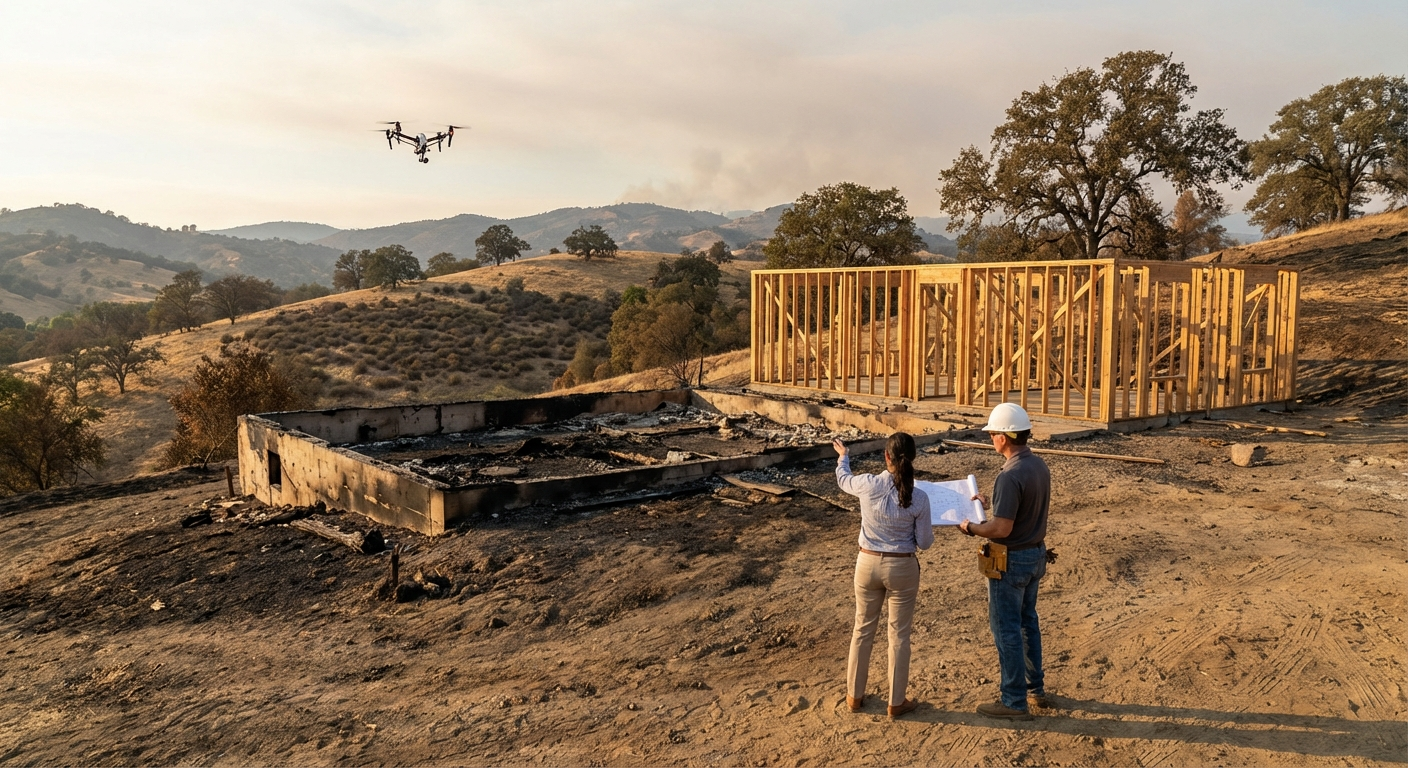
Which brings up something most people miss. Your home’s market value? That’s what a buyer might pay you today. Your home’s *rebuilding cost*? That’s what it would actually take to clear the rubble and put up an identical structure from scratch. And in California, those two numbers are often miles apart.
Why Your Old Policy Might Be Outdated
Think about your home. When was the last time you really looked at what it would cost to rebuild it? Not just what you paid for it, or what Zillow says it’s worth, but the actual brick-by-brick, nail-by-nail expense. For many, that number has shot up dramatically.
Inflation plays a huge role here. The price of building materials — lumber, concrete, roofing tiles — has gone through the roof. Finding skilled labor after a major fire event? That’s another challenge entirely, driving up wages even further. A home that cost, say, $300 a square foot to rebuild five years ago might now be $500 or even $600 a square foot. It’s a staggering difference.
Then there are the local rules. After a fire, cities and counties often update their building codes. They might demand more fire-resistant materials, stricter defensible space requirements, or new construction methods. You can’t just rebuild what you had; you have to rebuild to *today’s* standards. And that means more money out of pocket, often for things your old policy didn’t account for.

Beyond the Sticker Price: What Really Drives Your Premium Up
It’s easy to feel like insurance companies are just pulling numbers out of a hat. But behind those rising premiums are some very real, and sometimes unfair, factors.
Location, Location, Location… and Brush
You’ve heard it before: real estate is all about location. Well, fire insurance is too. If your home sits near a canyon, backs up to open space, or is nestled in the wildland-urban interface (WUI) — that blurry line where developed areas meet undeveloped wilderness — you’re considered higher risk.
Insurers use sophisticated fire maps and risk scores. They look at how close you are to brush, the slope of your property, the type of vegetation around you, and even the width of the roads leading to your home. Live in a high-risk zone? Your premiums will reflect that. Even if you’ve never had a fire on your street, the collective risk of your neighborhood pushes your costs higher.
The Age of Your Home and Its Defenses
An older home often costs more to insure. Why? Because older construction materials might not be as fire-resistant, and the building techniques aren’t up to modern code. It’s not just about how old your house is; it’s about what you’ve done to protect it.
Have you replaced your roof with fire-resistant materials? Are your vents protected against ember intrusion? Do you maintain excellent defensible space around your property, clearing dry brush and trimming trees? These improvements can sometimes help, but it’s an uphill battle. The state of California is trying to incentivize these actions, but the insurance market is still struggling to catch up.
The Insurer’s Perspective
Insurance companies aren’t charities. They’re businesses that have to pay claims. When claims spike due to massive wildfires, they adjust their models. They look at past losses, future predictions, and the sheer cost of doing business in a high-risk state like California.
The California Department of Insurance (CDI) plays a role, too, regulating rates and trying to balance consumer protection with insurer solvency. It’s a constant push and pull. But when the numbers show billions in losses, it’s hard for insurers to justify keeping rates low. Sometimes, they just decide it’s not worth the risk, leading to fewer options for homeowners.
Are You Truly Covered? Understanding Key Policy Features
So, you’ve got a policy. Great. But is it enough? Knowing what’s in your policy can make all the difference when disaster strikes.
Dwelling Coverage: The Foundation
This is the big one. Your dwelling coverage is the amount your insurance company will pay to rebuild your home. Most policies offer “replacement cost value” (RCV), meaning they’ll pay to replace your home with a new one of similar quality, without subtracting for wear and tear. That’s what you want.
Some older or less robust policies might offer “actual cash value” (ACV), which factors in depreciation. That’s a big difference. If your roof is 15 years old and costs $20,000 to replace, an ACV policy might only give you $8,000 because of its age. You’d be on the hook for the rest. Always, always aim for RCV.
Extended Replacement Cost and Ordinance/Law
Here’s where it gets interesting. Even if you have RCV, your dwelling coverage might not be enough. Imagine your home burns down, and suddenly everyone in your area is trying to rebuild. Demand for materials and labor skyrockets. Your original $500,000 dwelling coverage might only get you a $400,000 rebuild.
That’s why *extended replacement cost* is so important. This coverage adds an extra cushion, often 20-25% (or more) above your primary dwelling limit. So, a $500,000 policy with 25% extended coverage gives you up to $625,000 to rebuild. It’s a lifesaver when costs surge after a disaster.
But wait — there’s more. *Ordinance or Law coverage* is another must-have. When your home is rebuilt, it has to meet current building codes. These codes change, especially after major fires. This coverage pays for the extra costs to bring your rebuilt home up to those new standards, like adding sprinklers or using specific fire-resistant materials, even if your old home didn’t have them. Without it, you could be facing tens of thousands of dollars in unexpected expenses.
Personal Property and Loss of Use
Beyond the structure of your home, what about everything inside it? Your furniture, clothes, electronics, keepsakes. That’s your personal property coverage. Many policies offer a percentage of your dwelling coverage for this, say 50-75%. But it’s often not enough, especially if you have a lot of valuable items. Keeping a detailed home inventory — photos, videos, receipts — makes claims much easier.
And where will you live while your home is being rebuilt? That’s what “loss of use” coverage is for. It pays for your temporary living expenses — rent, hotel stays, even extra food costs — while your home is uninhabitable. Rebuilding can take months, sometimes years, in California. This coverage is absolutely essential for maintaining some normalcy during a chaotic time.
What You Can Do Right Now
Feeling a little overwhelmed? You’re not alone. The good news is, you’re not powerless.
First, pull out your current policy. Don’t just file it away. Take a hard look at those numbers: your dwelling coverage, extended replacement cost, ordinance or law, personal property, and loss of use. Are they still realistic for today’s rebuilding costs in California?
Next, get a professional rebuild cost estimate. A qualified appraiser or contractor can give you a much better idea of what it would *actually* cost to rebuild your specific home. This isn’t just guesswork; it’s a data-driven assessment.
Honestly, the best step you can take is to talk to an independent insurance agent. They work for you, not just one insurance company. They can shop around, explain the nuances of different policies, and help you find the right coverage, even in a challenging market. Karl Susman, with LA Fire Coverage Insurance (CA License #0B75129), has been helping Californians sort through these exact issues for years. He understands the local market and the frustrations homeowners face.
Don’t wait until it’s too late. You can start the conversation and get a clear picture of your options.
Ready to review your coverage? Get a personalized quote today: https://lafirecoverageinsurance.com/quote/
Which brings up something most people miss. Beyond the policy, focus on home hardening and defensible space. Trim those trees, clear the brush, install ember-resistant vents. These actions not only make your home safer but can sometimes influence your insurability and even your rates, if not immediately, then in the long run as insurers adapt.
Finally, keep a robust home inventory. Seriously. Take photos and videos of every room, every closet, every item. Store them in the cloud or on an external hard drive away from your home. It’s a tedious task, but it will save you immense heartache and thousands of dollars if you ever need to file a personal property claim.
Don’t leave your biggest asset to chance. Get a fire insurance quote tailored to your California home’s needs: https://lafirecoverageinsurance.com/quote/
Frequently Asked Questions
Why are so many insurance companies pulling out of California or limiting new policies?
Insurers are facing immense financial pressure from the increasing frequency and severity of wildfires across California. They’ve paid out billions in claims, and the risk models they use show continued high exposure. To manage their financial stability, many companies are reducing their presence or tightening their underwriting standards, especially in high-risk areas.
What is the FAIR Plan, and is it a good option?
The FAIR Plan (Fair Access to Insurance Requirements) is California’s “insurer of last resort.” If you can’t get fire insurance from a traditional carrier, the FAIR Plan will provide basic fire coverage. It’s better than nothing, but it’s often more expensive and offers less comprehensive coverage than a standard policy. You’ll usually need to pair it with a “Difference in Conditions” (DIC) policy from another insurer to cover perils like liability, theft, and water damage.
How often should I review my fire insurance policy?
You should review your policy at least once a year, ideally with an independent agent like Karl Susman. Don’t just wait for your renewal notice. Major home improvements, significant inflation, or changes in local building codes can all make your existing coverage insufficient. A yearly check-up ensures you’re always adequately protected.
Does my home’s market value affect my fire insurance coverage?
Not directly, no. Fire insurance is based on the cost to *rebuild* your home, not its market value. While market value might be high in California, the actual construction costs for rebuilding can be even higher, especially after a disaster. It’s a common mistake to confuse these two numbers, and it can leave you severely underinsured.
What’s the biggest mistake homeowners make regarding fire insurance?
The biggest mistake is assuming their current policy is enough without verifying the dwelling coverage, extended replacement cost, and ordinance/law coverage against today’s rebuilding costs. Many people are drastically underinsured and don’t realize it until it’s too late. It’s always better to be over-prepared than under-protected.
***
This article is for informational purposes only and does not constitute financial advice.