
Debris After a Wildfire: Why Your Fire Insurance Might Not Be Enough
When a wildfire rips through a California community, the images on the news show burned-out homes, charred trees, and a landscape of ash. It’s devastating. For homeowners, the immediate shock often gives way to a long, complex recovery process. Most people think their fire insurance will cover everything, especially clearing away the mess. But here’s the thing: that mess — the debris removal — can be a huge, hidden cost, and your policy might not stretch as far as you assume.
Myth #1: My Standard Policy Covers All Debris Removal
Many homeowners sleep soundly believing their standard homeowner’s policy will handle all the wreckage after a fire. The short answer is yes, it covers *some* debris removal. The real answer is more complicated.
Your typical HO-3 policy, the most common type in California, usually includes a provision for debris removal. This coverage is meant to help clear your property of damaged structures and other remnants so rebuilding can begin. But here’s where it gets interesting: that coverage isn’t unlimited. Often, it’s a sub-limit, meaning it’s a specific, smaller amount nested within your overall dwelling coverage.
For example, your policy might state it covers 5% or 10% of your dwelling coverage for debris removal. If your home was insured for $500,000, that’s $25,000 to $50,000 for cleanup. Sounds like a lot, right? Not always. Especially not after a major wildfire event in places like Ventura County or the Inland Empire.
Why does it matter? The sheer volume of debris from a completely destroyed home is immense. Think about a 2,000-square-foot house. Every stick of wood, every piece of drywall, every appliance, every bit of personal property — it all turns into a massive pile of ash and rubble. And it all needs to be hauled away.

Myth #2: Debris Removal is Just Hauling Away Ash and Rubble
This is a big one. Most people picture a bulldozer and a dump truck. They imagine a quick sweep, and then the site’s ready for new construction. That’s a romantic, but wholly inaccurate, vision of post-wildfire cleanup in California.
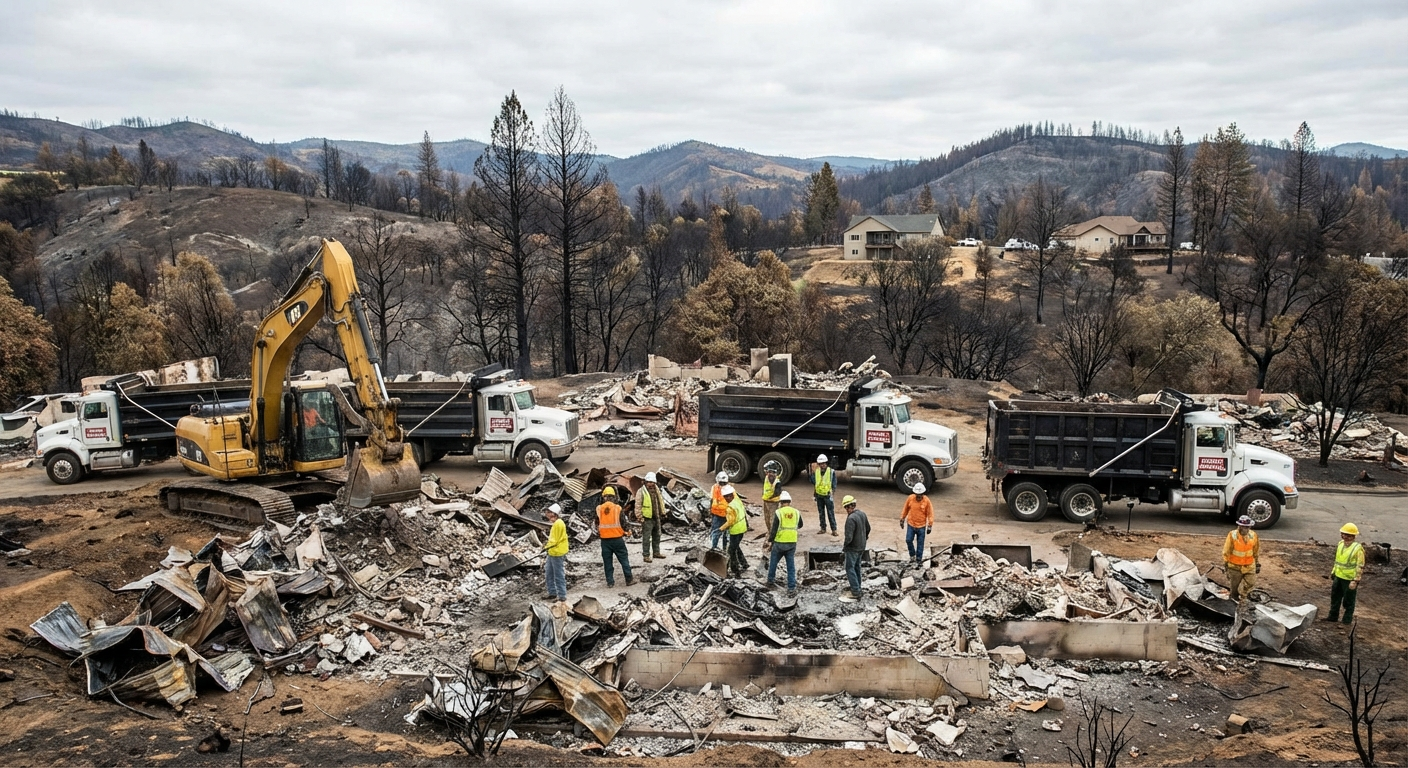
Post-fire debris isn’t just inert ash. It’s often a toxic cocktail. Homes built before the 1980s likely contain asbestos in roofing, insulation, and flooring. Lead paint was common for even longer. Then there are all the household chemicals: cleaning supplies, pesticides, pool chemicals, propane tanks, electronics with heavy metals, even the remnants of your car in the driveway. All of it melts and mixes into a hazardous stew.
This isn’t a job for just any contractor with a backhoe. Clearing a burned-out property requires specialized teams. They need to test for asbestos and lead. They need permits. They need to follow strict environmental regulations set by CAL FIRE, CalRecycle, and local county agencies. Often, the debris must be separated and disposed of at specific hazardous waste facilities, not just any landfill. This process is slow, meticulous, and incredibly expensive.
Three things drive your premium up. The cost of specialized labor. The cost of testing and permits. The cost of transporting hazardous waste to approved sites. This isn’t just a few thousand dollars; it can easily run into the hundreds of thousands for a full cleanup, especially if your property is on a hillside or has access issues.
Myth #3: The State Will Handle Everything If I Lose My Home
After devastating events like the Camp Fire or the Woolsey Fire, state and federal agencies often step in to assist with debris removal. CalRecycle, for instance, has managed massive cleanup operations. They’ll often coordinate with FEMA and the Office of Emergency Services (OES) to offer programs that help homeowners clear their properties.
But here’s the catch: these programs aren’t guaranteed for every fire. They’re usually activated for major disaster declarations. Even when they are, there can be long waiting lists. Imagine waiting months, sometimes over a year, for your property to be cleared while you’re paying a mortgage on a non-existent house and renting somewhere else. That’s not a fun situation.
Which brings up something most people miss. Even with state programs, you often have to “opt-in,” and sometimes you have to assign your insurance benefits for debris removal directly to the state or county. This means your insurer pays the state instead of you, or the state covers the difference if your insurance falls short. It’s a bureaucratic dance, and it’s not always simple. Relying solely on the state to pick up the pieces can leave you in limbo, financially and emotionally.
Myth #4: I Can Just Hire Any Contractor for Cleanup
Think again. This isn’t just about finding the cheapest guy with a truck. As mentioned, the presence of hazardous materials like asbestos and lead means you need certified, licensed contractors. They must follow strict safety protocols to protect their workers and prevent further environmental contamination.
If you don’t use a properly licensed and insured contractor, you could be on the hook for fines, future environmental cleanup costs, or even liability if someone gets sick from exposure. Plus, your insurance company might not pay for work done by unapproved contractors, or if the work isn’t up to code. It’s a mess you absolutely want to avoid.
Finding these specialized contractors after a major fire can be tough too. Demand skyrockets, and prices often follow. That $25,000 sub-limit on your policy starts looking pretty small when you’re getting quotes for $150,000 or more for a proper, compliant cleanup.
Myth #5: Debris Removal Costs Are Minor Compared to Rebuilding
For most California homeowners, especially those in high fire-risk areas, this is probably the biggest misconception. Rebuilding a home is expensive, no doubt. But clearing the site first can be an enormous, unexpected bill that depletes your available funds for reconstruction.
Consider a home in the canyons of Malibu or the hills of Santa Rosa. After a fire, the debris might include not just the house, but also retaining walls, burned-out vehicles, swimming pool remnants, and even contaminated soil that needs to be removed. Access can be difficult, requiring smaller equipment or more manual labor, driving costs skyward.
We’ve seen cleanup costs exceed $200,000 for a moderately sized home in California. If your policy only provides $50,000 for debris removal, that’s a $150,000 gap you’re suddenly responsible for. That’s money that could have gone towards upgrading your new home, or simply covering your living expenses while you wait to rebuild. It’s a gut punch.
Myth #6: My FAIR Plan Policy Will Give Me Plenty of Debris Removal Coverage
The California FAIR Plan is often a last resort for homeowners in high fire-risk areas when traditional insurers like State Farm, AAA, or Farmers won’t offer coverage. It’s better than nothing, absolutely. But it’s also a bare-bones policy designed to meet minimum requirements, not to offer extensive coverage.
Generally, FAIR Plan policies have very modest limits for debris removal. You might find it’s capped at 10% of your dwelling coverage, similar to standard policies, but with a much lower overall dwelling limit to begin with. Some policies might even have a hard cap, say $25,000 or $50,000, regardless of your dwelling coverage.
If you’re relying on a FAIR Plan policy, it’s even more critical to understand these specific limitations. You’re already in a challenging insurance situation; you don’t want to find yourself with an unexpected six-figure bill for cleanup after a fire.
So, What Should You Do?
First, pull out your current homeowner’s policy. Look specifically for the section on “Debris Removal.” Note the percentage or the specific dollar amount stated. Is it a sub-limit? Is it part of your dwelling coverage, or an additional amount? These details matter.
Next, think about the potential cost. If your home is older, or if you live in an area prone to complex cleanups, that standard 5% or 10% might be wildly insufficient.
This is where a knowledgeable agent makes a huge difference. Someone who understands the unique challenges of California’s fire season and the specific requirements for cleanup. Karl Susman of LA Fire Coverage Insurance, CA License #OB75129, spends his days helping Californians navigate these exact situations. He can help you understand your current coverage and explore options for increasing your debris removal limits. Sometimes, you can add an endorsement to your policy for a relatively small premium increase that significantly boosts this coverage. It’s often the best money you’ll ever spend.
Don’t wait until the smoke clears to find out you’re underinsured for one of the most immediate and costly aspects of fire recovery.
Curious about your options? Get a quote and discuss your specific needs. Visit https://lafirecoverageinsurance.com/quote/ to start the conversation.
Frequently Asked Questions About Fire Debris Removal
How long does debris removal typically take after a wildfire?
Honestly, it varies a lot. If it’s an isolated incident, it might be weeks to a few months. After a major wildfire, like the ones that have hit the Valley or Northern California, it can easily take many months, sometimes even over a year, especially if state-coordinated cleanup programs are involved. Testing for hazardous materials alone can take weeks.
Can I just clear the debris myself to save money?
Technically, you *could*, but it’s highly unadvisable and potentially dangerous. As we’ve discussed, fire debris often contains hazardous materials like asbestos and lead. Without proper training, equipment, and permits, you’re putting yourself and others at serious risk. Plus, improper disposal can lead to legal issues and fines. Most insurance companies also require licensed contractors for this type of work.
What if my debris removal costs exceed my policy’s limit?
If your costs go over your policy’s sub-limit, you’re generally responsible for the difference out of pocket. This is why understanding your coverage *before* a fire is so important. In some major disaster scenarios, state or federal assistance programs might help cover the gap, but that’s not guaranteed and often comes with its own set of rules and delays.
Does my policy cover debris removal for trees and vegetation?
Usually, standard fire insurance will cover the removal of burned trees and vegetation from your property if they pose a direct threat to insured structures or are blocking access. However, there are often specific limits or exclusions. It’s not typically for general landscaping cleanup, but rather for safety and to facilitate rebuilding. Always check your specific policy language.
Is debris removal coverage part of my dwelling coverage or additional living expenses?
Debris removal coverage is usually a separate sub-limit within your dwelling coverage, meaning it’s a portion of the total amount insured for your home. It’s not typically part of your “additional living expenses” (ALE) coverage, which pays for temporary housing and other living costs while your home is uninhabitable or being rebuilt. They are distinct coverages, each with its own limits.
Don’t leave your post-fire cleanup to chance. Get informed. Get protected.
Ready to review your coverage and ensure you’re truly prepared? Reach out to an expert like Karl Susman. Get a personalized quote today: https://lafirecoverageinsurance.com/quote/
This article is for informational purposes only and does not constitute financial advice.